
Fairbairn, Shanghai, and the Birth of Modern Combatives
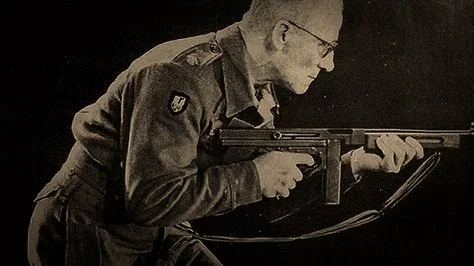
W.E. Fairbairn
What the world's most influential close-combat instructor learned on the deadliest beat in history, and why it still matters in the first three seconds of a violent encounter.
A system born in scars, not theory
Most fighting systems are built in gyms. A few are built on battlefields. William Ewart Fairbairn built his on the streets of Shanghai, and he had the scars to prove it.
When Fairbairn joined the Shanghai Municipal Police on 7 January 1907, he was a 21-year-old former Royal Marine assigned to one of the city's worst red-light districts. He did not stay unbloodied for long. Within his first years on the force, gang members ambushed him, stabbed him repeatedly, and left him for dead. He spent months in the hospital. The National Park Service's history of OSS training notes that "much of his body, arms, legs, torso, even the palms of his hands, were covered with scars from knife wounds."
That night in the alley did something to Fairbairn that no dojo could have done. It convinced him, in his bones, that the difference between living and dying in a real fight had almost nothing to do with what he had been taught in boxing class. He went looking for something better, and he spent the next thirty-three years building it.
By the time he retired from the SMP in 1940 as Assistant Commissioner, he had created the world's first SWAT team, the world's first shoot house, and the philosophical foundation for nearly every modern combatives and reality-based self-defense program in existence. Then he went to war and taught it to a generation of commandos and OSS operatives whose names are still spoken in whispers.
This is the man whose work sits at the root of what we teach in Contact Distance Combatives. Understanding him is understanding why we train the way we do.
The deadliest beat on earth
To grasp why Fairbairn's system looks the way it does, you have to understand the city that produced it.
Shanghai in the early twentieth century was a jurisdictional accident. After the Opium Wars, the British, American, and French concessions had carved the city into three competing zones, each with its own police, laws, and courts. Officers from one zone could not enter another without permission, and extradition was a paperwork nightmare that gave criminals all the time they needed to disappear. No passport was required to enter Shanghai. It became a magnet for fugitives from every corner of the world.
Into this vacuum stepped the Green Gang, which by the 1920s counted roughly 100,000 members. A contemporary journalist described its leader, Du Yuesheng, as running "an empire of crime that outranged in evil even that of Al Capone in Chicago." The numbers are difficult to absorb. An estimated 100,000 prostitutes worked the city by the 1930s. Gambling revenue exceeded one million dollars per week. Armed robberies in the International Settlement climbed from 47 in 1922 to 448 in 1926.
Then came the politics. The May 30th Incident of 1925, when SMP officers fired on Chinese demonstrators, lit a fuse that burned for years. The 1927 Shanghai Massacre saw Chiang Kai-shek's Nationalists, backed by Green Gang muscle, slaughter thousands of Communists. Japanese forces invaded the city's outskirts in 1932 and again in 1937. By the late 1930s, the western suburbs had become a "Badlands" of assassinations, bombings, and machine gun raids.
Roughly 6,000 SMP officers were expected to police more than a million residents through all of it. Criminals routinely carried Mauser C96 pistols, which is why Fairbairn ended up designing his own Mauser-proof body armor for his men. The historian Robert Bickers, the leading academic authority on the SMP, calls Shanghai in this period "one of the world's most crime-ridden and dangerous cities." That is the laboratory in which Fairbairn's methods were tested. Every technique he kept, he kept because it worked on a real human being who was trying very hard to kill him or one of his officers.
How many fights, exactly?
You will see it everywhere online: Fairbairn was personally involved in "over 600 street fights." It is a striking number, and it may even be true, but the honest answer is that nobody has produced the records to prove it.
The most rigorous accounting comes from researcher Leroy Thompson, author of The World's First SWAT Team. Thompson documents that, over a roughly twelve and a half year period, Fairbairn analyzed about 2,000 gunfights and was "personally present at over 200 of them." In those incidents, 260 criminals were killed and 193 wounded, at a cost of 43 police officers killed and 100 wounded.
Even the conservative figure is staggering. Two hundred gunfights witnessed firsthand is more than most career soldiers will ever see. It is enough. Fairbairn's credentials do not need inflating.
Cross-training before cross-training had a name
One of the most underappreciated facts about Fairbairn is that his system was genuinely multicultural at a time when most Western martial artists treated Asian arts as exotic novelties.
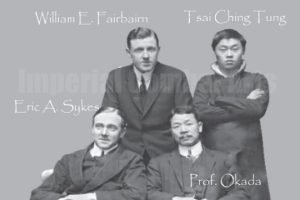
He studied Yoshin-ryu jujutsu under Professor Okada, a Japanese bonesetter living in Shanghai, for about three years. He earned a 2nd dan black belt from the Kodokan in Tokyo, with both certificates personally signed by judo founder Jigoro Kano. He trained in Chinese internal arts, almost certainly baguazhang, under Tsai Ching Tung, who had once instructed the personal retainers of the Dowager Empress. He cross-trained in boxing, wrestling, and savate. A 1919 SMP training manual was co-authored by Fairbairn, his eventual partner Eric Sykes, Okada, and Tsai Ching Tung. Picture that collaboration: a British police inspector, an English businessman, a Japanese jujutsu master, and a Chinese internal arts teacher, all sitting down together in 1919 to write a fighting manual.
This is the lineage we draw from when we tell students at Contact Distance Combatives that the source of a technique matters less than whether it survives contact. Fairbairn proved that nearly a century ago.
The Reserve Unit and the first shoot house
The May 30th Incident did not just change Shanghai politics. It changed Fairbairn. In December 1925, he formed the SMP Reserve Unit, which is now widely recognized as the world's first SWAT team. By 1929 it had grown to 145 members: European officers, Chinese constables carrying concealed Colt pistols, and Sikh riflemen with Lee-Enfield carbines. They had Thompson submachine guns, riot shotguns, gas guns, and bulletproof shields for clearing stairways. Their response vehicle, the "Red Maria," was mounted with a swivel-fired Thompson. In nearly thirteen years, the Reserve Unit responded to more than 2,000 riots and fights, 666 of which involved shooting.
Fairbairn also built what may have been his most quietly revolutionary creation: the "Mystery House," nicknamed by his men the "House of Horrors." It was a multi-room shooting facility with pop-up targets, varying light, sound effects, and deliberately disorienting surprises. It is, by any reasonable definition, the first shoot house in history, and the direct ancestor of every force-on-force facility in modern military and law enforcement training.
In his own words, the Mystery House was designed so that "under varying degrees of light, darkness, and shadows, plus the introduction of sound effects, moving objects, and various alarming surprises, an opportunity is afforded to test the moral fiber of the student and to develop his courage and capacity for self control."
Read that line again. It is 1925, and Fairbairn has already understood something that the modern training industry is still relearning: technique without stress inoculation is decoration.
What made the system different
Fairbairn published his methods first as Defendu in 1926, then revised as Scientific Self-Defence in 1931, and finally as the wartime manuals All-In Fighting (UK, 1942) and Get Tough! (US, 1942). Across all of them, three principles set his work apart from every other fighting system of his era.
First, ruthless pragmatism over technical elegance. Fairbairn explicitly rejected anything that took too long to learn. As he wrote in All-In Fighting: "No-one will dispute the effectiveness of a straight left or a right hook to the jaw or body, but unfortunately it takes months of practice to develop a good punch." So he built his system around the edge-of-hand blow and the chin jab, gross-motor strikes that he claimed could be brought to functional use in days, not years. His criterion was simple. If it worked and it could be taught fast, it stayed. If it was sport, ceremony, or theater, it was cut.
Second, psychology beats technique. This is the line that separates Fairbairn from mere collectors of moves. He wrote: "The principal value of the training lies not so much in the actual physical holds or breaks, but in the psychological reaction which engenders and fosters the necessary attitude of mind which refuses to admit defeat and is determined to achieve victory." The preface to one of his manuals, written by Lieutenant Colonel O'Brien Twohig, put the goal even more bluntly: "To conquer our ingrained repugnance to killing at close quarters." Fairbairn understood that the deciding factor in a violent encounter is rarely the move you choose. It is whether you can act at all in the half-second when acting is possible.
Third, training has to look like the real thing. His point-shooting doctrine, drawn from analyzing thousands of actual gunfights, threw out deliberate sight alignment for close-range work. From Shooting to Live: "In the great majority of shooting affrays the distance at which firing takes place is not more than four yards. Very frequently it is considerably less." And: "The average shooting affray is a matter of split seconds. If you take much longer than a third of a second to fire your first shot, you will not be the one to tell the newspapers about it. It is literally a matter of the quick and the dead."
That last sentence could be the epigraph for everything we do at Contact Distance Combatives.
From Shanghai to Inverailort to Camp X
In 1940, Fairbairn and his marksmanship partner Eric Sykes returned to Britain, reportedly with crates of contraband Shanghai weapons in tow. Both were commissioned as second lieutenants in the British Army on 15 July 1940. Fairbairn was recruited by the Special Operations Executive and earned the nickname "Dangerous Dan."
He taught at Inverailort House and other Special Training Centres in Scotland, drilling British Commandos, SOE agents, and Allied special forces in close combat, knife work, point shooting, and silent killing. In 1941 he appeared in a training film narrated by David Niven, who had personally trained under him. He moved on to Camp X, the SOE school near Oshawa, Ontario, and in April 1942 was lent to the OSS, where he trained operatives at every camp the agency ran and appeared in a training film directed by John Ford. The National Park Service, summarizing his impact on American special operations, calls him "one of the world's foremost experts on close combat techniques," and notes that "none of the American trainees who saw him in action would ever forget him."
He co-designed the Fairbairn-Sykes fighting knife, of which nearly two million were produced before the war ended. He designed the Smatchet, a brutal close-combat chopper. He finished the war as a Lieutenant Colonel and received the U.S. Legion of Merit at the personal request of OSS founder William "Wild Bill" Donovan.
His protégé Dermot "Pat" O'Neill, a fellow SMP veteran with a 5th dan in judo, went on to teach hand-to-hand combat to the First Special Service Force, the famous "Devil's Brigade." Rex Applegate, an American officer who trained under Fairbairn in Britain, ran the OSS close combat program at Area B (now Camp David) and later wrote Kill or Get Killed, the U.S. military's standard close combat manual for decades. Every one of these lineages traces back to one man and the lessons he learned the hard way on a Shanghai beat.
What Fairbairn still teaches us
It is worth being honest about what Fairbairn was and was not. His system was designed for wartime killing and police survival in an extraordinarily violent city. It was not built for modern civilian self-defense in its original form. Anyone teaching from his work today, including us, is adapting it to a context he did not directly design for. Better to acknowledge that openly than to pretend otherwise.
But the underlying principles travel just fine. They are why Contact Distance Combatives exists.
Fairbairn understood that real violence happens close, fast, and ugly. Four yards or less. A third of a second to act. No referee, no weight class, no second round. He understood that the techniques that survive contact are gross-motor, simple, and trainable in weeks rather than years. He understood that the psychological work, the willingness to act decisively in the worst moment of your life, matters more than the catalog of moves you have memorized. And he understood that training has to introduce stress, surprise, and consequence, or it is not training. It is choreography.
Master the first three seconds. That is our tagline, and it is not marketing. It is a debt we owe to a man who spent thirty-three years learning, in the hardest possible classroom, that the first three seconds are usually the only seconds you get.
If you are over-invested in a single tool, whether that tool is a pistol, a punch, or a particular grappling system, Fairbairn's life is a warning. He never stopped cross-training. He never stopped analyzing what actually happened in real fights versus what was supposed to happen. He kept what worked and threw out the rest, and he was willing to do that even when what he was throwing out was tradition, ceremony, or his own previous opinions.
That is the standard. That is the inheritance. And in a small evening class on a Tuesday in Portland, with five students on the mats and ninety minutes to work, that is the lineage we are trying to honor.
Contact Distance Combatives teaches close-quarters self-defense for the critical first seconds of a violent encounter. Classes are held weekly in Portland, Oregon, with a maximum of five students per session. Learn more at our classes.
